Compostable products are often presented as a simple solution. In reality, their performance depends on the conditions in which they are collected and treated.
Waste infrastructure varies between countries and regions. Industrial and home composting also operate under different conditions. Understanding compostability certification is therefore not only about recognising a logo. It is about understanding what has been assessed, which conditions the certification covers and whether the product is suitable for the waste system it will enter.
What does compostability certification mean?
A compostability certification is more than a general claim. It provides independent verification that a specific product, material or component has been assessed against defined requirements. Depending on the applicable standard or certification scheme, the assessment may include requirements for:
- biodegradation under specified conditions
- physical disintegration during the composting process
- regulated substances and other material characteristics
- effects on the composting process
- the quality of the resulting compost
Certification applies to specific products and compositions. A certification held for a raw material does not automatically cover every finished product made from that material. Components such as printing inks, adhesives, coatings and additives may also need to be included in the assessment. The certification marking on the individual product shows which composting conditions it has been assessed for.
The compostability standards and certification schemes most commonly found on consumer products generally cover either industrial or home composting.
- Industrial composting in Europe
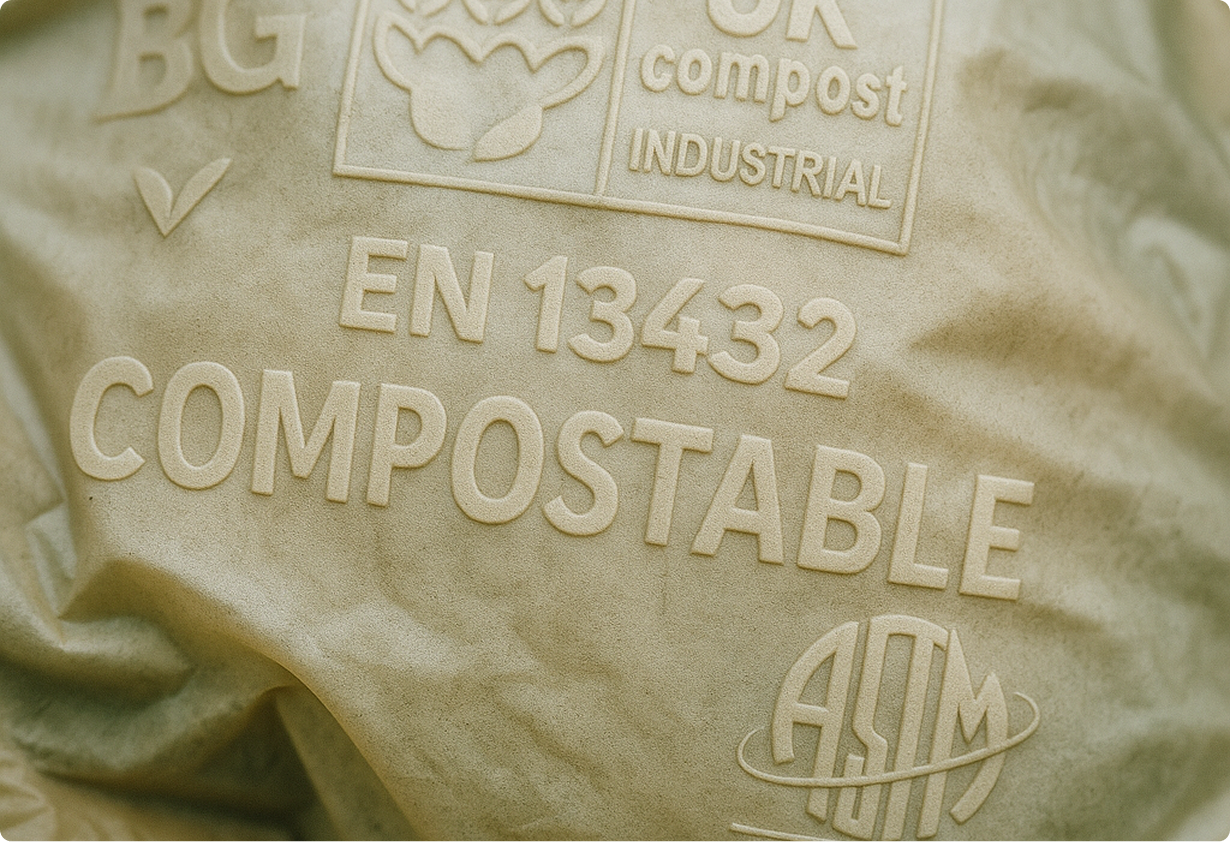
EN 13432 sets requirements for packaging recoverable through industrial composting and biodegradation. Certification schemes such as OK compost INDUSTRIAL independently verify that products meet the applicable requirements. - Home composting in Europe
OK compost HOME is a certification scheme operated by TÜV AUSTRIA for products assessed under home-composting conditions, where temperatures are generally lower and less consistent than in industrial facilities. - North America
ASTM D6400 sets requirements for plastics designed for composting in municipal or industrial aerobic composting facilities. BPI provides third-party certification for qualifying products and packaging. - Australia
AS 4736 applies to biodegradable plastics suitable for industrial composting, while AS 5810 applies to biodegradable plastics suitable for home composting.
Industrial and Home Composting are different
Most recognised certifications for compostable consumer products are designed for either industrial or home-composting conditions. Industrial composting takes place in controlled facilities where factors such as temperature, moisture, oxygen and biological activity are managed. These facilities generally operate at higher and more consistent temperatures than home composting.
Home composting takes place at lower and less predictable temperatures. Conditions can vary according to the climate, the composting method, the materials added and how actively the compost is managed. Home compostability must be assessed separately.
Industrial Composting in Europe
EN 13432 is the European standard for packaging recoverable through industrial composting and biodegradation. It establishes test methods and criteria for assessing the compostability of packaging under controlled treatment conditions. The assessment covers characteristics including biodegradation, disintegration during biological treatment, effects on the treatment process and the quality of the resulting compost.
OK compost INDUSTRIAL is a certification scheme operated by TÜV AUSTRIA. It provides independent verification that the applicable requirements for industrial composting have been met. Products carrying the OK compost INDUSTRIAL mark are intended for suitable industrial composting conditions.
Home Composting
OK compost HOME is a separate certification scheme for products assessed under home-composting conditions. Home composting generally takes place at lower and less consistent temperatures than industrial composting. The certification requirements therefore reflect a different treatment environment.
Many Biobag bags are certified according to OK compost HOME. This provides independent documentation of their performance under the conditions covered by the certification scheme. Home-compostability certification does not mean that a product should be discarded in nature. A home compost is a managed biological environment and is not equivalent to soil, a roadside, a forest, freshwater or the ocean. Always check the certification marking on the individual product to understand which conditions it has been assessed for.
Compostability certification in North America
In North America, ASTM D6400 establishes requirements for plastics designed for composting in municipal or industrial aerobic composting facilities.
The Biodegradable Products Institute, commonly known as BPI, operates a third-party certification programme for compostable products and packaging in North America. BPI-certified products must meet the applicable ASTM requirements and additional eligibility and certification criteria.
BPI certification applies to commercial composting conditions. It does not demonstrate home compostability unless a product carries a separate certification covering home-composting conditions.
Acceptance also varies between composting facilities and local collection programmes. A product may be certified but still not be accepted by every local facility.
Compostability standards in Australia
Australia has separate standards for industrial and home composting. AS 4736 specifies requirements for determining the compostability or anaerobic biodegradation of plastics, while AS 5810 applies to biodegradable plastics suitable for home composting. Products must be independently assessed and certified before they can carry the applicable certification mark. As in other regions, certification should be considered together with local collection and treatment requirements.
What certifications don’t tell you
One of the most common misunderstandings is that a certified product will break down anywhere. That is not what certifications are designed to guarantee. They document performance under the conditions covered by the relevant standard or certification scheme. Performance may differ when the required temperature, moisture, oxygen or biological activity is not present. Certification also does not account for incorrect disposal and does not guarantee that a product will be accepted by every municipality, waste collector or composting facility.
From product to waste system
A compostable product is not only a material choice. It is part of a chain that includes how the product is used, collected, sorted and treated. Certification documents how a product performs under specified conditions, but it does not replace suitable collection and treatment infrastructure. It also does not prevent incorrect disposal or contamination by non-compostable materials. This distinction matters. A product can be correctly certified but still be unsuitable for a particular local waste system if the relevant collection or treatment infrastructure is not available.
Why local guidance matters
Waste-management systems differ between countries, municipalities and treatment facilities. Some organic-waste systems accept certified compostable bags, while others require different collection methods. Always follow the guidance provided by the relevant municipality, waste collector or treatment facility. The product’s certification marking explains the conditions it has been assessed for, while local guidance determines whether it should be used and how it should be sorted in that location.
Understanding certification in context
Compostability certifications define where and how a product is expected to perform. They provide independent documentation and help businesses, municipalities, waste operators and consumers make more informed product choices. Their value lies not only in the certification mark itself, but in understanding what sits behind it: defined requirements, controlled testing, independent assessment and a specific intended treatment environment. When certification is understood in context and combined with appropriate collection and treatment, it becomes a useful tool for making decisions within complex waste systems.
Understand Biobag’s certifications
Biobag offers certified compostable products for different applications and treatment conditions. Explore our certification information to understand what the different marks mean, and visit the relevant product page to see which certifications apply to the product you are considering.